FROFL Roll Off Rental
New builds, additions and remodels

Construction Dumpster Rental for Florida Job Sites

Containers for framing scrap, drywall, packaging, block and stucco, with swaps when the job runs long. Built around how Florida sites actually work: sand, rain and tight lots.

Call (407) 250-9022
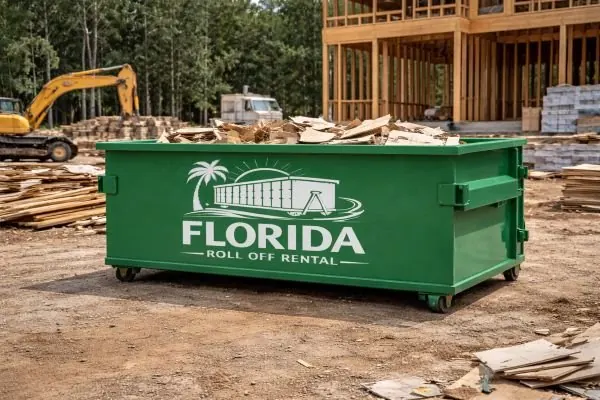
Green dumpster on a dirt construction site in front of a timber-framed building, with an excavator and stacked lumber nearby

Containers that keep a site moving

Construction dumpster rental in Florida is about two things: having the right container on site when the crew needs it, and getting a swap fast when it fills. We line up independent haulers who work construction sites in your county, and the provider handles delivery, swaps and final pickup. Call (407) 250-9022 with the site address and the stage of work.

Matching the container to the stage

Different stages make different debris, and that changes what you should order:

  • Site clearing and demolition. Heavy material. Concrete, block and old slab belong in a small container, often a 10-yard. Vegetation is best kept separate.
  • Framing and sheathing. Light, bulky offcuts. A 30 or 40-yard works well.
  • Drywall and finish. Heavy by volume. A 20 or 30-yard, and watch the tonnage.
  • Final clean. Packaging, crates and leftover material. One last 20 or 30-yard often finishes it.

Our construction dumpster rental tips go into scheduling, placement and avoiding overage charges.

Florida site realities

Lots in newer Florida subdivisions are tight, and every trade needs a spot for its trailer. Agree on the container's spot before the slab is poured, keep it clear of where the concrete truck and the pump will set up, and leave the driver a straight approach. Rainy-season afternoons can turn a sandy lot to mud, so think about access when the ground is wet, not just when it is dry.

Where a lot is too small for a container, it may have to go in the street. Many Florida cities treat that as a right-of-way use that needs a permit, sometimes with reflectors or barricades. Our permit guide covers the general picture; the city has the final word.

Hurricane watch on an open site

When a storm is forecast, an open container full of light debris becomes a problem. Ask the provider whether they can swap or remove containers ahead of a storm, and tie down or remove loose material. After the storm, damaged homes nearby will be competing for the same containers.

What to tell us

The address, the type of build, the stage you are at, roughly how long the job will run, and whether you want swaps on call or on a schedule.

Usually fine to load

  • Framing offcuts, sheathing and trusses scrap
  • Drywall, insulation and ceiling board
  • Packaging, pallets, banding and window crates
  • Stucco, lath and lightweight demolition debris
  • Old doors, windows and cabinets from a remodel

Ask first or keep out

  • Cans of paint, adhesives, sealants and solvents
  • Treated-lumber sawdust bags where restricted
  • Asbestos-suspect materials from older buildings
  • Large amounts of concrete mixed with light debris
  • Fuel cans and generator oil
Need to know

Florida dumpster questions, answered

How often can a construction dumpster be swapped?

As often as the job needs, within the provider's schedule. Swaps are priced per haul in most quotes, so ask what the turnaround is after you call for one.

Can a dumpster sit on a dirt lot?

Yes, but the ground has to hold the truck and a loaded container. After summer storms a sandy lot can turn soft fast. A compacted spot near the road or some boards under the rails helps.

Should concrete block go in a separate container?

Usually, yes. Block, stucco and concrete are heavy, and clean loads can often go to a recycler. Mixing them into a 30-yard of framing scrap can blow through the weight allowance.

Do I need a permit for a dumpster on the job site?

Not normally on private property. If the container must sit in a street or right-of-way, many Florida cities want a permit. Our permit guide covers the usual process.

What size is best for a new single-family home?

Builders often run a 30 or 40-yard for framing and drywall stages, swapped as needed. A 20-yard suits additions and remodels.

No-obligation pricing

Tell us the city and the job

Have your address, dates and project type handy and the call takes a few minutes.

Call (407) 250-9022